
Library → Models and frameworks → Impact/effort prioritsation matrix
Whether you’re getting to grips with your personal time management, or thinking more strategically as a team manager, prioritising tasks effectively is crucial.
One valuable framework to manage tasks thoughtfully is through the use of an Impact-Effort Matrix, a simple tool that can transform the way we approach work, yielding maximised productivity and minimised stress.
The impact vs. effort matrix
Let’s take a look at this simple template. ‘(Impact’ is sometimes known as ‘benefit’ or ‘value’, while ‘effort’ is roughly synonymous with ‘complexity’, ‘cost’, ‘feasibility.’ So an analysis like this could also be known as ‘value vs effort’ or ‘benefit vs cost.’ )
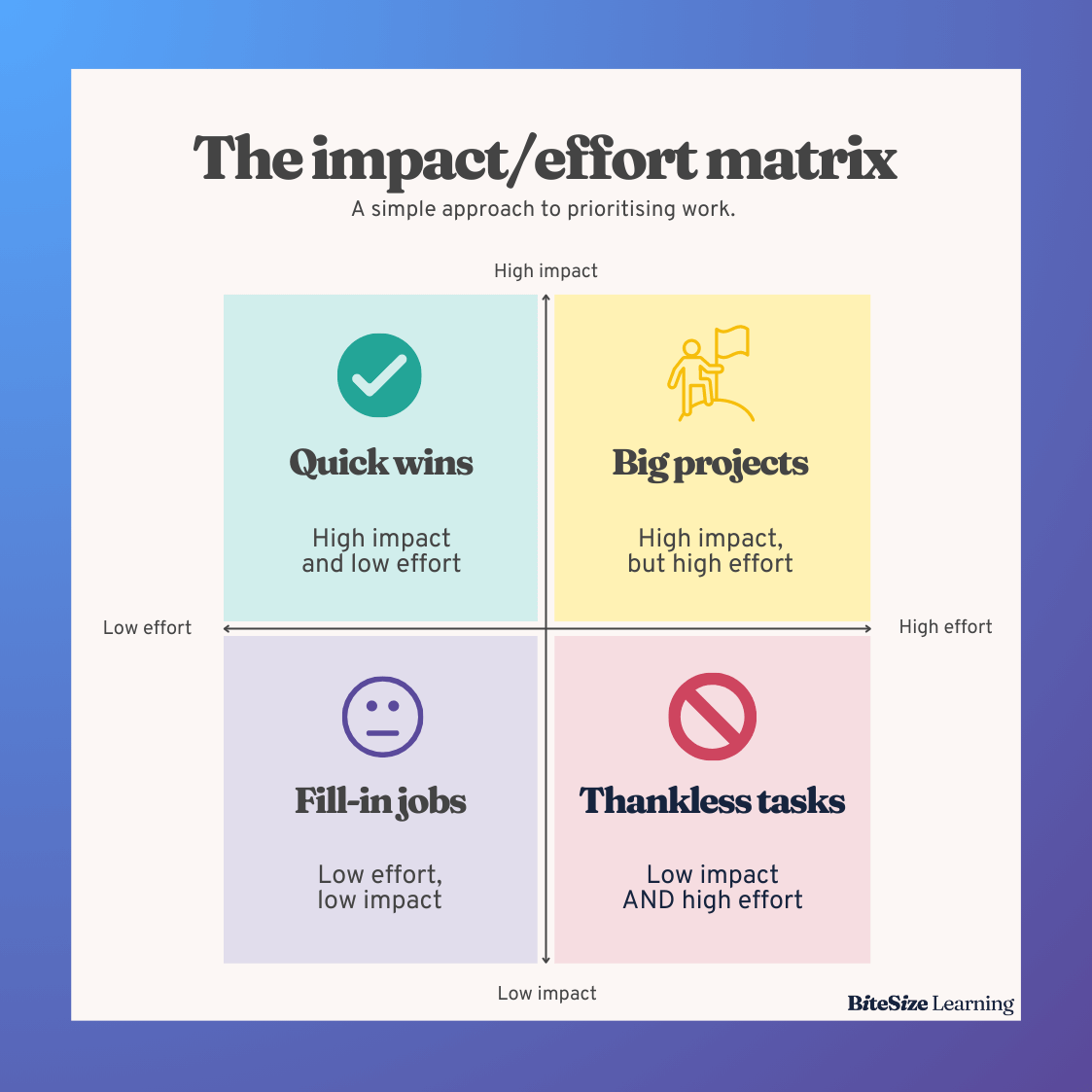
The Impact-Effort Matrix is a 2x2 grid that sorts tasks by their anticipated 'impact' — the benefits they're likely to provide — and 'effort' — the work they require to complete. This matrix gives us four quadrants:
Quick wins
These tasks offer a major impact for not very much effort – the dream! These easy pickings are hard to find, but will naturally be a priority.
Major projects
These initiatives also offer a major impact, but with an attendant amount of hard work. Before you begin, you’ll want to be confident your impact estimate is on solid ground.
Fill-in jobs
These jobs don’t move the needle all that much, but they don’t require much work either. They aren’t a huge priority, but most roles involve a fair amount of ‘fill-in jobs’ – it’s all about keeping them under control.
It’s important not to put in more effort on these than justified – bear in mind, it’s all time you could be spending on more high-impact work. One method to control fill-in jobs is to time-box them: for instance, you might schedule a daily hour for admin and minor requests, leaving the rest of the time to focus on high-impact work. On a bigger scale, a tech or design team might devote a two-week period each quarter to fixing minor bugs, fulfilling odd requests and generally tidying up code.
Thankless tasks
These low-impact, high-effort tasks are where dreams go to die, and should be avoided wherever possible. But it’s not always that easy. A major project that delivers less impact than predicted, or a fill-in job that drags on for longer than you thought, are both thankless tasks in disguise.
Estimating effort and impact
A successful application of the Impact-Effort Matrix, like many project management frameworks, relies heavily on accurate estimates of impact and effort for each task. 'Impact' could be measured by the potential return on investment, client satisfaction, or progress towards strategic goals, depending on the specific context. 'Effort', on the other hand, could include time, cost, or resources required.
Think outside your role: A piece of work may not seem all that ‘impactful’ from where you sit, but try to understand the wider business context – it could make a big difference to someone else. On the other hand, this can leave you vulnerable to Endless ‘Serious’ Requests where everyone is trying to convince you precisely how important their request is. If you deal with a lot of incoming requests, try to build a rough framework to triage them by effort and impact, share the criteria, and be open about how this influences your response time.
Make impact more specific: Impact is a pretty vague and generic term, so if you or your team have a particular set of targets, you should refer to these instead. For example, if you’re a customer service team targeted on ‘customer satisfaction score’, ‘time spent per issue’ and ‘response time’, you can assess how each initiative is like to impact each of the three metrics. If one metric is more important than the others, you can use weighting to give it additional sway in the prioritisation.
Be granular, if needed: Sorting tasks into four boxes can be a bit simplistic. Instead, you could give an impact score out of 5 and ‘hours estimated’ to arrive at a more accurate prioritisation.
Consider changing the tasks themselves: If you can make a Thankless Tasks easier or more impactful, then they’ll become worthy of consideration. Similarly, a Fill-In Job that makes an additional impact, or a Major Project that you find an easier way to accomplish, could become a high priority Quick Win. Use the ‘Five Whys’ framework to zoom out (what is the task ACTUALLY trying to accomplish?) and then see if you can find a differently-designed solution that can be accomplished more swiftly.
Tasks can move through the matrix once they’re underway: if a Fill-In Job starts to take more effort than expected, or a Major Project is failing to make an impact, it may have become a Thankless Task. So it might be worth re-thinking, imposing a ‘hard stop’ to limit further work, or abandoning altogether, even if you’ve already started. Don’t be a hostage to the Sunk Cost Fallacy.
Watch out for bias: Most of us are natural optimists, prone to under-estimating the work required and over-estimating possible benefits. On a personal level, other cognitive shortcuts like the anchoring bias, recency bias or Dunning-Kruger effect can impact our decision-making for the worse. And we’re all especially bad at estimating tasks that we don’t have much experience with. Where appropriate, seek input from others who may use different priors to make their estimates.