
There's a specific kind of dread that sets in on a micromanaged sales team - the paralysis that comes from knowing every email, every call recording, will be pulled apart by your manager. That kind of scrutiny doesn't improve performance, it just kills the things that actually close deals: creativity and human connection.
The sales manager’s instinct to control is understandable… when targets are looming, it feels safer to dictate exactly how a team should perform. But the research shows that teams need a level of autonomy and safety to perform effectively - plus happy employees are 31% more productive and achieve 37% better sales performance!
(We can all agree, most micromanaged employees are not particularly happy.)
The secret to hitting those numbers isn't tighter control, it's swapping micromanagement for coaching culture.
The high cost of "helpful" hovering
Most managers don't set out to be ‘micromanagers', they just think they’re being supportive. But when you solve every problem for your team, you’re inadvertently signalling that you don’t trust their abilities.
This creates a cycle of dependency, because if a salesperson feels they can't make a move without a green light, they stop thinking strategically. They stop taking the creative risks, like trying a new angle in a pitch, that lead to breakthroughs. Ultimately, it erodes psychological safety, the very foundation people need to naturally thrive and perform.
Coaching is the ultimate sales hack!
Coaching isn't about just giving all the answers (in fact that’s a big sin in the coaching world!), it’s about asking the right questions to unlock a person’s potential and help them figure things out, often more quickly and with better results. It moves the relationship from a clinical, process-heavy interaction to one rooted in human connection, learning and improved performance.
When you coach your sales team, you’re doing more than just fixing a deal; you’re building their "EQ" (emotional intelligence). This is vital because sales is fundamentally about relationships. A salesperson who feels supported and empowered is far better at building the trust and cooperation needed to close a sale.
The transition to a coaching style leads to what we call natural performance:
Better Relationships: Coaching builds trust between the manager and the team.
Psychological Safety: Teams feel safe to learn from mistakes rather than hiding them.
Happier Teams: Employees who have autonomy and feel connected to their work are more engaged.
Higher Performance: Engaged teams show 18% higher productivity and 23% higher profitability.
If you're ready to trade the clinical approach for a coaching mindset, start with these three steps:
Question your why: Next time you feel the urge to intervene in a rep's process, ask yourself if you’re doing it to improve the outcome, or just to have it done ‘your way’. (The ‘correct way’ and ‘your way’ can often feel like the same thing - but are they? Can the outcome be achieved differently? Be honest!)
Ask, don't tell: Instead of saying "You should say X in the next meeting," try "What do you think the client's biggest hesitation is? How could we address it?"
Focus on the human, not just the "operating system": Your team members aren't just units of production. Celebrate their wins, support their growth, and focus on creating a positive learning culture where they actually enjoy the work, and have the support to improve their own performance.
We’ve written a lot on micromanagement - here’s an excerpt from one of those blogs that might be useful!
What causes micromanagement?
Most people don't set out to become micromanagers. It usually develops for understandable, if misguided, reasons.
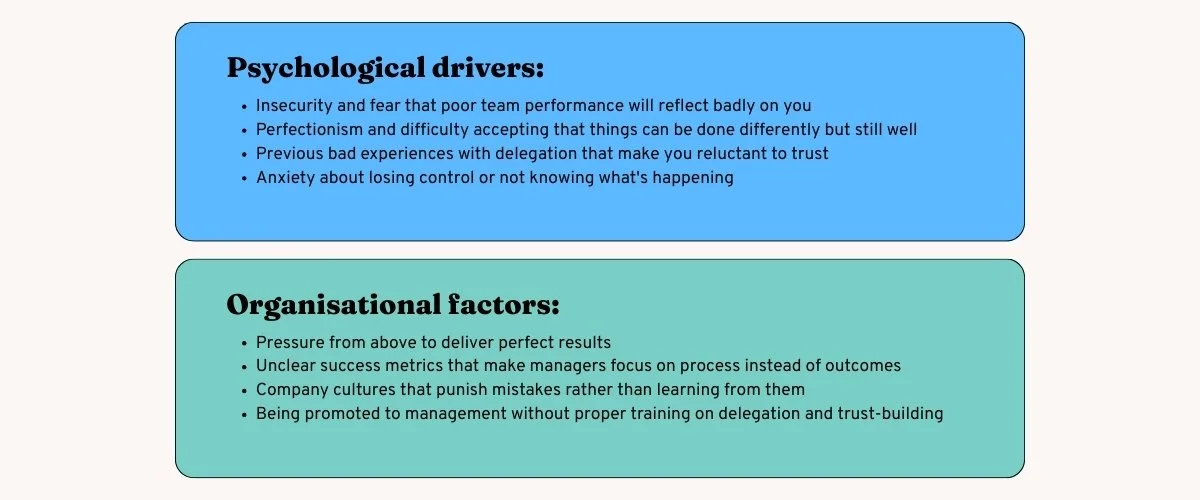
The irony is that most micromanaging comes from caring about quality and wanting good results. The problem is that the methods actually work against those goals.
Questions to ask yourself
If you're wondering whether your management style has tipped over into micromanaging territory, here are some honest questions to ask:
Am I changing things that are already working fine?
Do I find myself looking for problems rather than celebrating what's going well?
When I give feedback, am I focusing on real issues or just stylistic preferences?
Would I be happy if elves did this work overnight and it met my standards?
Am I solving problems my team should be solving themselves?
Am I spending more time checking and adjusting their work than they spent doing it?
Are people asking permission for things they used to decide independently?
The answers don't have to be perfect, but they'll give you a sense of whether you're managing outcomes or trying to control every detail of the process.
Moving from micromanaging to coaching isn't just about being "nice." It’s a scientifically-grounded strategy to drive better business results by putting people first.
