
Intrinsic vs extrinsic motivation at work
If you've ever taken your team out for Friday lunch only to watch their energy evaporate by Monday morning, you already know this. Rewards get people moving, but they don't keep them going. The kind of motivation that actually lasts comes from somewhere else entirely! This article breaks down intrinsic versus extrinsic motivation, shows you where each one actually works, and gives you some practical ideas for building the kind of motivation that sticks around.
First, the simple definitions
Intrinsic motivation involves people doing an activity because they find it interesting and derive spontaneous satisfaction from the activity itself.
Extrinsic motivation, however, is different. It is about doing the work to get a separable outcome, for example, pay, affiliation or status.
Both matter in organisations, the question is when and how to use each.
How motivation impacts performance
This large meta-analysis that pooled results from 40 years of research found that “intrinsic motivation predicted more unique variance in quality of performance, whereas incentives were a better predictor of quantity of performance.”
In other words, rewards can help you get more of something. But if you need careful, creative, customer-centred work, you also need people to care about the work itself.
Do rewards undermine intrinsic motivation?
Sometimes! If the rewards feel controlling, or tied too tightly to simply starting, finishing or hitting a number, people can end up chasing the prize rather than caring about the work. That can sabotage drive and initiative, especially on complex tasks where judgment and creativity matter.
Rewards can still help, the trick is how you use them. Treat rewards as acknowledgement rather than pressure, and keep choice on the table.
In practice, you can explain the why, invite their input on goals and approaches, and give feedback that builds confidence, whilst recognising progress and learning (as well as outcomes). When used in this way, rewards sit alongside intrinsic drivers, instead of crowding them out.
Autonomy, competence and relatedness
Self-Determination Theory proposes three basic psychological needs that fuel intrinsic motivation:
Autonomy: people feel they have meaningful say over how work gets done.
Competence: people make progress on tasks that stretch them just enough, with feedback that helps them get better.
Relatedness: people feel part of a team that has their back and a shared sense of purpose.
If you meet these needs, you’ll support better focus and project completion. If you don’t, you’ll spend your time chasing the team around with carrots and sticks (figuratively, not literally!).
A manager’s playbook for building intrinsic motivation
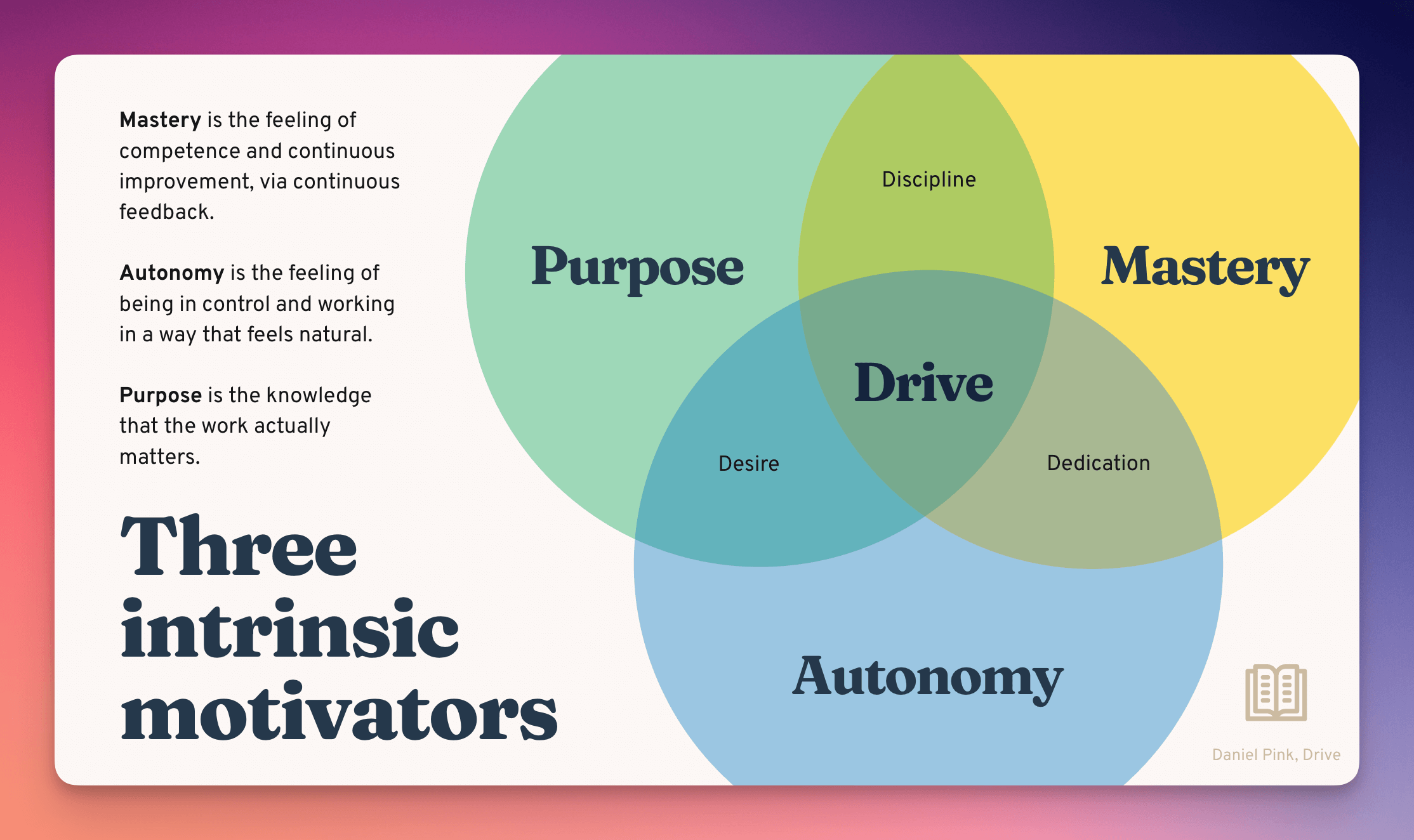
To engage deeply with work, Dan Pink (authored of Drive) explains that we need three key elements:
Autonomy – the chance to do things our own way, follow our instincts and feel like we matter
Mastery – a sense of growing confidence and competence, informed by rapid feedback that lets us understand whether what we’re doing is ‘working’
Purpose – the feeling that our work is having a genuine impact, and contributing meaningfully to something bigger, and part of a greater good, whether that’s for our colleagues, clients, or society at large
When all three come together, the depth of our motivation can inspire us to overcome all sorts of challenges, helping us navigate times of change and respond to setbacks with determination and resilience.
(This excerpt is taken from another of our blogs on working autonomously - read it here!)
When extrinsic rewards are helpful
Use rewards to reinforce clarity and progress, not to control people. A few things to keep in mind:
Keep rewards informational. Praise and recognition that highlight someone's competence tend to support motivation. Controlling messages (think "hit the target or else") tend to kill it.
Watch the contingency. The more controlling your incentives feel, the more likely they are to crowd out intrinsic motivation... especially for complex work where people need to think creatively.
Anchor rewards in an autonomy-supportive climate. In practical terms, this means inviting input on goals, treating people fairly, and explaining your rationale. When you do this, rewards shift from feeling like pressure to feeling like genuine acknowledgement.
Conversation prompts you can use this week
What part of this project feels most meaningful to you right now?
Where would a little extra freedom help you do your best work?
What would make progress feel more visible or satisfying this week?
Which skill are you keen to get better at, and how can I help?
What gets in your way that I can remove?
Common pitfalls to avoid
Over-relying on targets and bonuses for work that demands judgment or creativity. You will get more, not necessarily better.
Mystery recognition. Vague praise does not teach people what to repeat.
Big annual gestures instead of small weekly signals. Motivation is a loop, not an event.
Ignoring team dynamics. Unresolved conflict undermines almost every aspect of work quality.
Bringing this to life in two hours
Motivation improves fastest when managers actually practise these conversations, not just read about them. Our Motivating Others session gives managers a practical toolkit they can use the same day... things like autonomy-friendly goal setting, feedback that builds competence, and simple routines that make progress visible. We help you build happier teams because (and this shouldn't be a secret) happier teams perform better.
